
A list of trees, shrubs and plants found at the Rock School yard.
(This schoolhouse was continuously used from 1779 until 1911.)
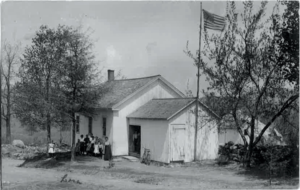 Throughout this paper, compass points are used as references. Colebrook Road (Route 183) is on the west side; Sandy Brook Road is on the south side; the long stone wall defines the
east side and the chimney of the school is on the north.
Trees
Wild Apple: An apple that grows from a seed will not generally produce eatable fruit. In order to get Red Delicious apples for example, a twig from a Delicious apple tree would be grafted
onto a wild apple. When the branch grew large enough it would produce Delicious apples. The wild apple at the Rock School is located about mid-point along the stone wall on the east side.
White Ash: The biggest one here is on the inside of the stone wall on the north.
Black Cherry: Most of the brush on the east side of the wall is black cherry. When these trees grow to maturity, they produce very beautiful wood, which sometimes is made into furniture.
Hemlock: Two young ones are to be found on the south edge of the school yard next to Sandy Brook Road. This road, by the way, used to be called the Rock School Road. When the building ceased to be used as a school, the road was renamed starting from the corner down past the town garage, where it continued on down to CT Rt. 8 as Sandy Brook Road. What used to be the north end of Sandy Brook Road was then renamed Phelps Flat Road.
Sugar Maple: The large tree next to the Colebrook Road is a sugar maple; the sap from which is made into maple syrup and maple sugar. It is also called a rock maple, due to the hardness of the wood.
White Pine: There are two or three small ones on the south side. White pine always has clusters of needles containing five leaves. A needle is what is known as a modified leaf.
Red Oak: The huge tree in the front yard, west of the school, is a red oak. It is 9 feet 4 inches around (or 112 inches). It is probably 180 or so years old. There is an international standard used in measuring the circumference of trees. Beginning on the uphill side (if it is on a slope), measure up 54 inches (or 284 centimeters), then measure around the bowl of the tree to get the circumference.
Poplar: There is one small one near the big rock at the corner. Perhaps it’s not such a good idea to let this establish itself, as poplars tend to spread quite fast and are hard to get rid of.
Red Sumac: This is also at the corner near the poplar. Like the poplar, it also spreads rapidly and is very difficult to eradicate.
Shrubs
Lilac: These ornamental shrubs, so beautiful in the springtime, were brought to this country from Europe by the early settlers. Ours is on the front lawn.
Pink Azalea: This shrub grows right by the front door. Locally, this is sometimes referred to as “swamp pink”, but actually the swamp pink is a small plant that grows in swamps. The pink azalea blossoms have usually gone by when Rock School Day rolls around.
Dogwood: Another of the several species of trees and plants along the south side of the yard. These are native shrubs, although they can be purchased at nurseries. There is a disease that is killing our dogwoods, but the ones here at the Rock School seem to be healthy.
Blueberry: Technically, these should be called high bush blueberries, as most of the commercial blueberries that are sold in the supermarkets are harvested from low bush blueberries. Many acres of these can be found up in Maine. Sometimes you will see blueberry bushes covered with netting to keep birds from eating them. Recently a flock of wild turkeys consisting of two adults and four young ones the size of hens were watched crossing a field on Beech Hill when they spotted a blueberry bush loaded with berries. It took less than five minutes for them to eat every single berry. The adults ate the higher ones, using those long necks of theirs, and the little ones hopped up, took a berry, hopped up and ate another and so on until the bush was bare. It’s a good idea to use netting!
Juniper: These evergreens produce blue berries, which some people find tasty. Don’t swallow them; just chew then for the flavor. They wouldn’t hurt you if swallowed. These berries are used to flavor the alcoholic beverage known as gin.
Mock orange: The tall shrub about midpoint along the east wall is a mock orange. This particular one is an Asiatic specie. There are 9 or 10 different types found in this country. The one we have has the nicest fragrance.
Meadowsweet: You will find this growing alongside the wall on the east side and also outside the north wall. Mother Nature does not like what we think of as nice lawns and open fields going right up to our stone walls. She prefers woods consisting of many different species. This is what we call reforestation. One of the first woody shrubs that start the process of reforestation is meadowsweet and its sister shrub steeplebush. Meadowsweet has a rounded flower cluster, steeplebush has a pointed one. These, along with red sumac, popular and gray birch are among the first to begin the transition from fields to forest. Before long the north wall will begin to have sugar maple and black cherry, just as the east wall now has. By the time you grow up and have children of your own, those black cherry on the east wall will be about a foot thick.
Barberry: Here is a shrub you don’t want to get too close to, as it seems to have more thorns than leaves! It produces many bright red berries in the autumn, which the birds eat during the winter. The inner bark and wood are bright yellow. It can be found alongside Sandy Brook Road not far from the hemlock tree.
Flowering Plants
Blackberry: There are a couple of these on the east side. The fruit ripens in late July and early August. The berries are good with cream and sugar, in pancakes, on cereals and in jams, jellies and pies. The young leaves make a nice drink when steeped in hot water. They have a branched stalk and much worse thorns than raspberry stalks.
Raspberry: These are also found on the east side. There are more thorns on these than blackberry, but they aren’t as hard and sharp. However, you won’t think so if you sit on one!
Bindweed: A member of the morning glory family. Like most vines they tend to wrap themselves around whatever they grow next to, thus binding everything together.
Poison Ivy: Over on the northeast corner and climbing over the wall is this most unwelcome guest. Early in the spring the clusters of three leaves are almost purple, later becoming green; either way, stay away! We have been trying to eradicate this patch of poison ivy for almost 15 years, but some still persists. If you miss the smallest piece of root, the plant will reestablish itself next year.
Bluets, or Quaker Ladies: The bluet forms practically a mat on some lawns and fields. The blossoms generally have four petals, which can be colored blue, white, yellow or combinations of these. Stop and look closely at them – they are a particularly beautiful plant.
Pussy Toes: Bristly flower heads, crowded together into a cluster resembling a cat’s paw, give this plant its name.
Common Blue Violet: Violet leaves contain high amounts of vitamins A and C, and can be used in salads or cooked as greens. The flowers can be made into candies and jellies.
Strawberry: These are in bloom throughout the month of May, and by June the ripe fruit can be seen peeping out from under its leaves. Although much larger and showier, the strawberries purchased in a store don’t come close to equaling the flavor of the wild strawberry.
Blood Root: Ours can be found at the highest point of the school yard next to Sandy Brook Road. In June, all that will be seen are the large, deeply lobed leaves. The white blossoms come out in May and only last a few days. The red juice from the roots was used by the Native Americans as a dye for baskets, clothing and as war paint, as well as for repelling insects. (How could you tell whether the Indian coming up the path was on the warpath or just trying to keep from being chewed up by mosquitoes)?
Dandelion: This is not a native plant, but came with the colonists from Europe. The name refers to the likeness of the leaf edges to those of a lion’s teeth. When young, they are quite good in salads. The blossoms are used to make dandelion wine. Most people hate them in their lawns, but if you look closely at the blossom, you will find it to be very beautiful.
Trout Lily: This early spring yellow blossom is accompanied by two mottled leaves, which resemble a trout when seen through shallow water.
Canada Mayflower: This small plant covers large areas of the forest floor, and can be found south of the schoolhouse under the hemlock.
Canadian Dwarf Cinquefoil: The easiest way to find one of these is to look for a small bright yellow flower growing close to the ground. The name comes from the French word for “five”, as it has five petals on the blossom as well as five leaves in each cluster.
Northern Bedstraw: Northern bedstraw belongs to a family of plants known as bedstraws, since the pleasant-smelling foliage was used to stuff mattresses in medieval times. A non-caffeine coffee substitute can be made by roasting the seeds after they turn brown in July. Roast in a warm oven (300°F) for about an hour until they become dark and crisp. Grind in a blender or crush on a hard surface. Simmer ¾ of a cup of these in one quart of water until it turns medium to dark brown. Strain and serve. Look for some by the north wall between the school and Colebrook Road.
Daisy: This is so named because the bright yellow center surrounded by white petals reminded people of the sun, and thus were known as “day’s eye”. They are so common that it seems as though they had always been here, but our daisy came from Europe.
Buttercup: Buttercups are another European import. The shiny, waxy texture of the buttercup petals is caused by a special layer of cells just beneath the surface. Don’t try to eat this plant; the juice from the stems and leaves are very acrid, which means it tastes terrible. That is why you will see so many of them in fields and pastures; the animals also know how horrible they taste! Young children will pick a buttercup and hold it close up under someone’s chin to “see if they like butter” (meaning that the reflection from the petal will give the skin a yellow hue).
Wild Oats: The pale yellow blossom of this spring plant hangs down like a long bell. You will find them along the south wall.
Solomon’s Seal: Look for a long, arching leaf-stalk with flowers hanging from the underside. The rootstalk of the Solomon’s seal is jointed; the leaf stalk breaks away from it, leaving a distinctive scar, which is said to resemble the official seal of King Solomon. Native Americans and colonists ate the starchy rhizomes (roots).
Solomon’s Plume (False Solomon’s Seal): This looks almost like Solomon’s seal, but the white flowers occur at the end of the long, curving leaf rather than on the underside. The rootstalk does not have the distinctive markings.
Goldenrod: There are 11 different kinds of goldenrod growing in Colebrook. When they are mature, you can figure out which one you are looking at, but that doesn’t happen until autumn. In the springtime it’s not difficult to find goldenrod leaves, but when it comes to identifying the exact type, do the same as most honest adults do – say “I haven’t the foggiest notion what kind of goldenrod this is”!
Trillium, Purple: This pretty spring flower does not have the best fragrance; in fact another name for it is “stinkpot”. The name trillium comes from the Latin word for “three”, as it has three petals as well as three leaves.
Wild Sarsaparilla: This plant can be found at the high point on the southwest corner. The leafless flower stem, topped with clusters of greenish-white flowers, is beneath a large, umbrellalike leaf. The aromatic rootstalks are used as a substitute for sarsaparilla.
Vinca (Myrtle): Myrtle is a ground-hugging evergreen trailing plant having purplish-blue five lobed flowers. It was brought to this country by the colonists, who planted it around their homes, where it went wild, and in some cases has continued to grow for more than 300 years. Sometimes it is the best way to locate old house sites. Myrtle continues to be a favorite groundcover; that’s why you will find it growing here.
Horseweed: No flowers will appear on the tall stalk of the horseweed until July at the earliest, but the leafy stalk may be seen on the highest point of land near the intersection of Sandy Brook Road and Colebrook Road. Native Americans and early settlers used a preparation of its leaves to treat sore throats.
White Snakeroot: The single stem bears flat-topped clusters of small, fuzzy white flower heads. In days gone by, when there were many more dairy cows about town than at present, farmers had to be careful not to let white snakeroot grow where cows could eat it, because ingesting this toxic plant results in milk that can be fatal to humans. White snakeroot can be found by the north wall.
Gill-over-the-ground: Another name for this plant is ground ivy. It was introduced from Europe. The name “gill” comes from the French word “guiller”, which means “to ferment”, because the leaves were used to help ferment, or flavor beer. This also will be found by the north wall.
Fleabane: Fleabane has small aster-like flower heads, but blooms much earlier than do the asters; as early as April to as late as August. Early colonists believed that by scattering the flower heads around the house, they could rid themselves of fleas, as the name “bane” means “deadly”, thus “death to fleas”.
Yarrow: The leaves of the yarrow have very fine teeth, much like a fern, with a pleasant, aromatic fragrance. Yarrow was formerly used for medical purposes: to break a fever by increasing perspiration, to treat hemorrhaging, and as a poultice for rashes. A tea used by the Native Americans to cure stomach disorders was made by steeping the leaves.
White Campion: This plant, when it blooms from July to October, has a white, balloonshaped blossom, which blooms at night so as to attract moths, which pollinate it. White campion can be found next to Colebrook Road at the northwest corner.
Yellow Wood Sorrel: The deep lemon yellow blossom has five petals and the leaves have three heart-shaped leaflets, which look very similar to shamrock. The leaves have a pleasant taste and seem to be sweet and sour at the same time.
Sheep Sorrel: This is a weed brought to this country from Europe. The leaves are shaped like a long arrowhead. The leaves can be eaten when young and tender.
Red Clover: Red clover is one of the favorite flowers of the bumblebee. If you pull out one or two segments of the flower head with your thumb and forefinger, place it on your tongue, then squeeze your tongue against your upper front teeth and gently pull out the blossom, a drop of honey will be left on your tongue.
Plantain: Generally called Common Plantain, this plant is related to the banana. If you ever happen to be at a pond that has ducks swimming on it, pick a plantain leaf, turn it so that the stem points upward, place a peanut or pieces of cracker on it, and it becomes a boat to carry the food out to the ducks.
Blue Eyed Grass: Here is a coarse grass that has a flower stalk up to a foot in height. The six-petaled flower is light blue with a yellow center.
Tawny Hawkweed: Locally, this is better known as orange Indian paintbrush. Originally brought here from Europe, but now it grows everywhere. There is another plant having a bright red flower named Indian paintbrush, but it generally grows in the middle part of the country.
Canada Hawkweed Like the tawny hawkweed, this is better known as yellow Indian paintbrush around here, but that is not its official name.
Butter-and-Eggs: Another name for this is toad-flax. The color of the flowers reminds you of egg yolks and butter.
Ragweed: For people with allergies, this is perhaps one of the worst plants that grow around here. Unfortunately, it is very common, grows everywhere and is difficult to get rid of.
Nightshade: This plant, although related to the tomato and potato, is quite poisonous. Fortunately, the small, oval green or red fruits don’t taste or smell very appetizing, but please – don’t ever eat these! A couple of these plants grow by the steps at the front door.
Heal All: The colonists believed that this little plant possessed medicinal qualities that were helpful in curing a lot of ailments; that’s why the name.
Vetch: This member of the pea family has escaped from hayfields, as it is not only good for horses and cattle, it also puts an element called nitrogen into the soil The flowers are purplishblue.
Burr Dock: Everyone at some time or other has gotten mixed up with the burrs of the burr dock. They also have a nasty habit of attaching themselves to our pets, especially dogs. They live several years and eventually have a taproot that goes down a foot and a half into the ground, making it almost impossible to get rid of; because when you pull one up, it breaks off just beneath the ground and before you know it, more foliage sprouts and the burr dock is as healthy as ever.
Grape Vine: The one we have grows at the end of the stonewall by the intersection of the two roads. It looks to be a concord grape, meaning that it started from the seed of a cultivated grape, not our native grape, which we call a fox grape. These vines can grow to a very large size. In the woods it is possible to find then 6 to 8 inches thick, and growing to the tops of the forest trees.
Milk Weed: This is a valuable plant, because on it the monarch butterflies lay their eggs. By eating the leaves of the milkweed, the monarch larvae become toxic, thus protecting them from birds that might eat them. The blossoms are in clusters of pinkish-purple color, and the sap is a sticky white substance, looking much like cow’s milk. The pupils of the Colebrook schools (we had 3 schoolhouses then) collected bags and bags of the seed pods in the fall during the war years of WWII. These were used to provide the filling for life jackets used by our armed forces.
Wild Lettuce: This is the tallest weed having a single stalk that we will find growing in Colebrook; it is not uncommon to find them 6 or 8 feet tall when they mature in the autumn. It doesn’t look much like the lettuce we buy at the store or vegetable stand, but they are closely related, and can be used as greens if you can find them when they are young.
Wild Mint: There are several mints that grow around here such as spearmint, peppermint and catnip, to mention a few. Look for ours alongside Sandy Brook Road.
Horse Tails: When this plant is young, it resembles a horse’s tail. Pull out one of the needleshaped leaves and see how they fit together. This is one of the oldest forms of plant life and has remained little changed for at least 300 million years. We know this because their impressions are found in coal beds, which we know to be that old. When camping, you can use a fistful of them to scour pots and pans; they really work well.
Dew Berry: This plant creeps along the ground, and if you looked quickly at it, you might think you were looking at cinquefoil, but the runners have little thorns on them, and when midsummer comes, the fruit looks and tastes like raspberries.
Helleborine: This is one of several orchids that grow in this area. Look for ours close to the foundation on both east and west sides.
Little Ladies’ Tresses: These are also orchids, but don’t look for their cream-colored blossoms spiraling up a short stem in the spring or early summer. Find them in the front lawn not far from the west corner of the schoolhouse.
This list of plants is not complete. In addition, a specie will grow in one spot for years, then just doesn’t appear the following year; so you may find that you can’t locate a certain flower no matter how diligently you search. There are also several kinds of mosses and grasses, as well as ferns that have not been entered in this list. This is primarily the compiler’s fault, as he does not know these forms of plant life as well as the flowering plants. This can be an opportunity for those of you who would like a project; identify as many forms of plant life as you can find (and don’t forget all those lichens on the stone wall)!
To the third grade of the Colebrook Consolidated School, who will experience a day in history here during a day in early June: the Colebrook Historical Society hopes to make this day one of the highlights of your school year, and we have compiled this list of trees, shrubs and plants with the hope that it will give you pleasure, enjoyment and knowledge.
To all others, who are always welcome and encouraged to stop here and experience a few quiet moments in Colebrook where time has stood still, we hope that you have a truly memorable visit.
Use the rest of this page to list plants that don’t appear here. Don’t forget to look for birds, butterflies, beetles and other insects.
— Compiled by the Colebrook Historical Society